We did not visit Arusha National Park in 1991, but did in 2003. It was our first destination on this safari. We stayed at Momella Lodge, an old lodge outside of the Park. Although we arrived at night, my children became excited as we caught sight of several cape buffalos illuminated by the beams from our vehicle’s lights. I had forgotten what it was like when I saw my first wild animal in Africa, and their enthusiasm soon became contagious.
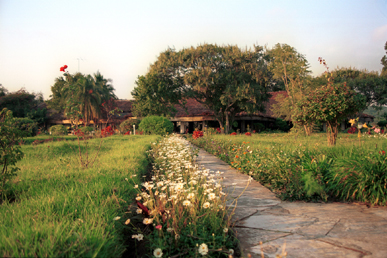
Momella Lodge
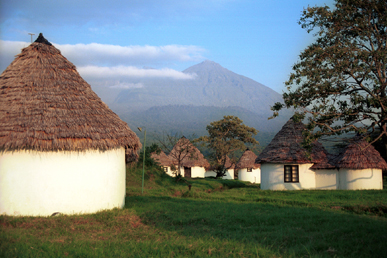
Momella Lodge with Mt. Meru Visible in the Distance
Momella Lodge probably saw its better days years ago when it was home to the crew filming the movie Hatari, starring John Wayne, Red Buttons and others. I doubt that it has been updated much since then. However, sidewalks are lined with flowers (together with admonishments not to pick the flowers), making for pleasant strolls, John Wayne’s Dining Room served more than adequate food and the Harvey Kruger Bar and Lounge was generously stocked. The guest facilities were round huts with thatched roofs and ensuite shower and toilet. And of course, when the sky is clear, Mt. Meru extends high above in the distance.
That first night, I was reminded of how cold it could be in Africa, notwithstanding that we were not that far south of the equator. I attribute it mostly to the altitude. That first morning, Irene and I were still in bed, covered in blankets and trying to stay warm, when a loud rap reverberated through our door at 5:30 in the morning. It was our children extolling us to come outside quickly – they had just spied several giraffes walking through the camp. The excitement of seeing wild animals up-close is the one element of Africa difficult to explain to people. They either understand it or they don’t.
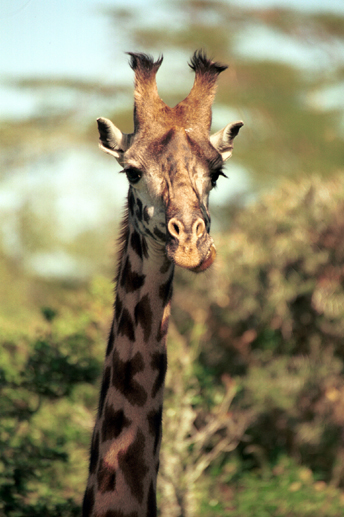
Since Arusha National Park is small, the wildlife inhabiting it is not abundant. There are two species which stand out most in my mind, that being the giraffe and flamingo.
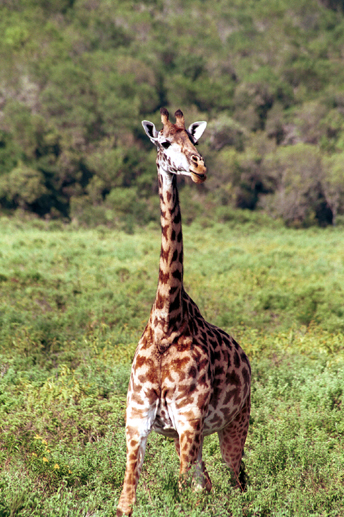
In addition to seeing these magnificent creatures in camp that first morning, we encountered them on several occasions while traversing the Park. The species here, as throughout northern Tanzania, was the Masai giraffe. We saw them as singles, in pairs and in groups of up to ten and more. And we saw them in open spaces, thick brush and heavy forest. They clearly were the predominant mammal that we encountered in the Park.
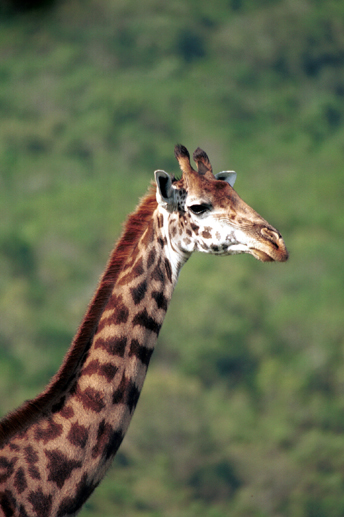
Masai Giraffe
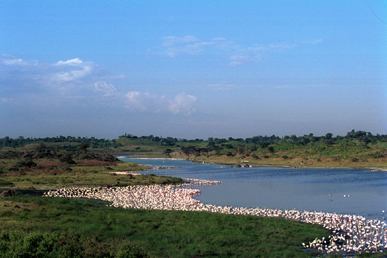
Flamingos Lining on of the Momella Lakes
Then there were the flamingos. Arusha National Park contains seven lakes referred to collectively as the Momela Lakes (Lake El Kekhotoito, Lake Kusare, Small Momela Lake, Lake Rishateni, Big Momela Lake, Lake Tulusia and Lake Lekandiro), all located within the northwest corner of the Park. Gary thought that, if we were lucky, there would be a substantial number of flamingos on the lakes at this time of the year. I was somewhat skeptical until we rounded a corner and came upon one of the lakes lined in pink. The birds were everywhere, both lesser and greater flamingoes, including juveniles.
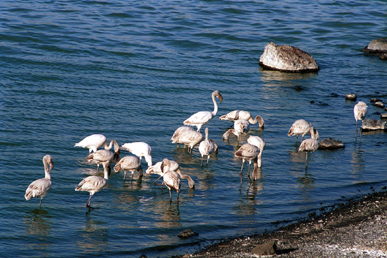
Immature Flamingos
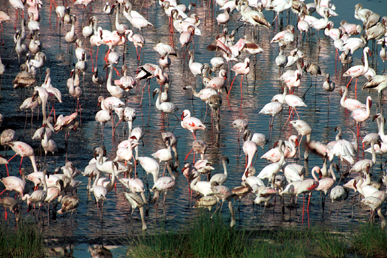
Mature and Immature Flamingos
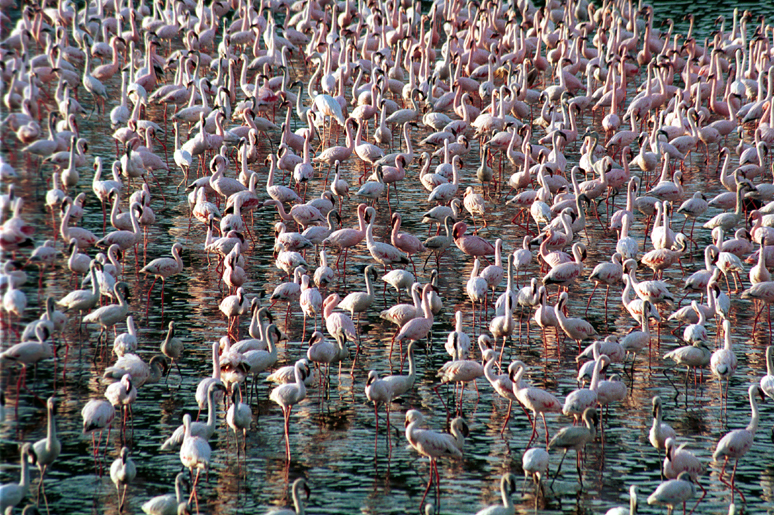
The Greater and Lesser Flamingos of Arusha National Park
Just when we thought we hand seen them all, around another corner we would run into more of these birds. I had never seen this many of these feathered creatures in one location, including in Ngorongoro Crater and at Lake Ndutu in the Serengeti. At one point, thousands of the birds took to flight, leaving behind trails in the water as they skimmed across the surface of the lake. This was truly a magnificent sight, and one I am not sure will be duplicated on any future safari that I might take.
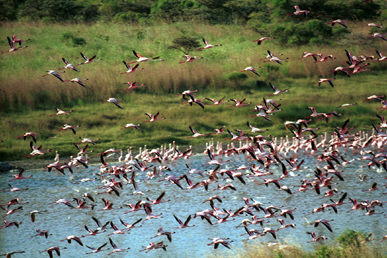
Flamingos in Flight
It was getting late in the afternoon and we decided that we needed to return to the Lodge. However, about this time, the clouds began to clear and Mt. Kilimanjaro became visible in the background. At this, we had to just sit and watch. The sun setting, providing the perfect light, the lake in the foreground, flamingos in the distance, and Kilimanjaro providing the backdrop. This one picture was worth the trip to Arusha National Park.
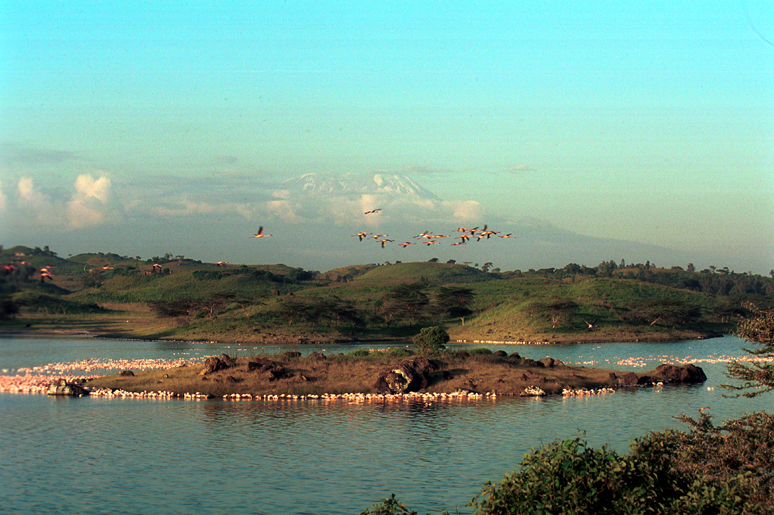
The setting Sun, a Momela Lake, Flamingos and Mt. Kilimanjaro
The above is not to suggest that Arusha National Park was home only to giraffes and flamingos. To the contrary, we ran into other mammals such as zebra, common waterbuck and warthogs, as well as a variety of monkeys, including blue monkeys, baboons and the black and white colobus monkey (with their exquisite long white tail). [We also saw a sign asking us not to take liberties with wild animals, whatever that meant.] However, those sightings were not as often as the two mentioned above.
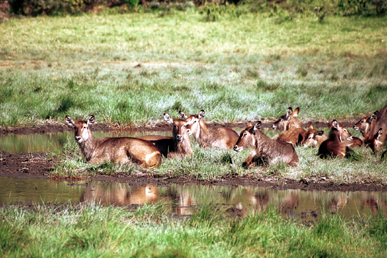
Common Waterbuck
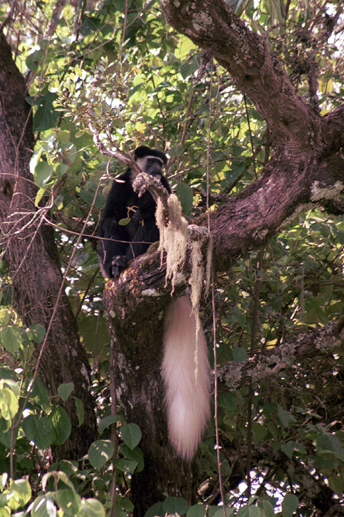
Black and White Colobus Monkey
One animal that we did see on two occasions was the red duiker. A small, elusive nocturnal antelope, this animal usually stays in thick vegetation or forest where light for photography is scarce. Out of the two sightings, all I could manage was one out-of-focus picture.
I enjoyed Arusha National Park, and I do believe it is worth a stay, even if only for one or two nights. My children especially enjoyed it since it was the first national park in Africa that they visited.
Footnotes
(1) See Arusha National Park, published by the Tanzanian National Park Service, edited by Deborah Snelson and illustrated by David Bygott.