White Giraffe Home
Prologue
Some Initial Thoughts
Tanzania
...Tarangire National Park
...Serengeti National Park
...Oldapai Gorge
...Ngorongoro Crater
...Lake Manyara National Park
...Arusha National Park
...Selous Game Reserve
......Rufiji River Camp
......Sand Rivers Camp
...Mikumi National Park
...Ruaha National Park
......Ruaha River Lodge
......Mwagusi Sand River Camp
...Zanzibar
Zimbabwe
...Zambezi National Park
...Victoria Falls
...Ivory Lodge
...Hwange National Park
...Sable Valley Lodge
...Mana Pools National Park
...Motopos Hills
Kenya
...Sweetwaters Game Reserve
...Samburu National Reserve
...The Ark
...Amboseli
...Masai Mara
Epilogue
Contact Us
Back to Hommert Central
RUAHA RIVER LODGE

Our stay in Ruaha National Park was shared between Ruaha River Lodge and Mwagusi Sand River Camp. However, due to the vagaries of the availability of lodging, we spent our first night at the Lodge, then two nights at the Camp and finally another two nights at the Lodge.

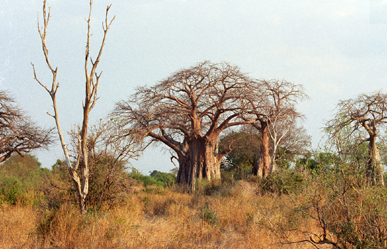
The Lodge is nestled in a kopje next to the Ruaha River, constructed in and around the various stones. Stone bandas, built from local stones gathered from the area, lined the River and provided the lodging for our stay. Toilet facilities were ensuite and the accommodations were excellent. The only drawback to the Lodge is that both the dining area and the bar are at the top of the kopje, requiring patrons to emulate klipspringers before they can partake of food or drink. However, the view from the top of the kopje is exceptional, whether peering up or down the River or looking over the baobab dotted landscape. Also, while traversing the paths to the top of the Lodge, you can come face to face with the rock hyrax which inhabit the kopje. Acclimated to human presence, the animals allow you to approach quite close.


Rock Hyrax
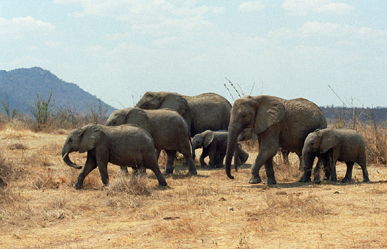


Elephant Herd


Baobab Trees


Female Greater Kudu

Being a National Park, our only options for game viewing were game drives and viewing from the porches of our bandas. Both provided excellent experiences. Driving into the Lodge, we encountered an enormous male lion, his mane very dark, sleeping under a tree next to the River. Agama lizards, with their bright orange heads and blue bodies standing out from their drab surroundings, were everywhere, climbing on trees and rocks alike. Kirk’s dikdik, a small antelope, were abundant, as were elephants. One herd of elephants passed the road in front of us. Comprised of individuals of various sizes, this presented a spectacular opportunity for determining the ages of elephants, which is generally determined by size. This particular herd ranged from a one to two year old to the matriarch, with many ages in between. Masai giraffe browsed on the tree tops, vultures perched in trees while Defassa waterbuck (another new animal for our checklist) drank from the cool waters of the Ruaha. Kudus moved in and out of trees and other brush in search of food. Zebras grazed on the open grasses, a large number of colts in tow. Helmeted guinea fowl were everywhere. (1)

The animals in this part of the Park were not that skittish, an indication that there was a larger tourist population in Ruaha National Park than in the Selous Game Reserve. Giraffes and kudu rarely moved from the side of the road as we stopped to view. Many of the elephants, instead of turning away, continued their trek across the road, sometimes directly at our vehicle. This always engendered a gasp of concern from Irene, prompting our driver to move further down the road.

Rainfall in the area usually fell between December through April. Since we were visiting the Park in October, much of the surface water had already evaporated, leaving the River as one of the remaining main sources of water. This resulted in a greater concentration of animals around the River during our visit, enriching the quantity and variety of our animal sightings.


Helmuted Guinea Fowl
(You can never see too many.)


White headed Vulture

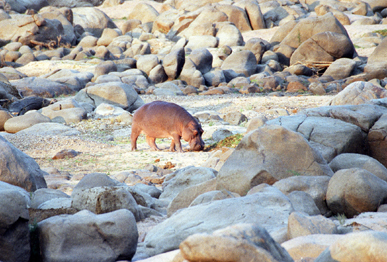
Game viewing from our porch was almost as good as from the back of a land rover. Bird life was abundant, from the golden tail woodpecker and the white-headed buffalo weaver which frequented the shrubs next to our banda, to the hamerkop that foraged for food from the River’s bank in front of our facility. African plated lizards scurried through the rocks of the kopje and hippos cooled their bodies in the waters nearby. The boulders lining the River and those exposed in the River’s bed dwarfed the hippos, making them appear much smaller than they really were. One particular hippo spent hours in the River, floating from point to point and blending in well with the boulders. Only when he lifted his head in a mighty yawn did he clearly stand out from his surroundings.


Hippo Amidst the Boulders

But one of the more remarkable sightings awaited our return to the Lodge for our second visit. Shortly before our arrival, and across the River from our banda, a pack of wild dogs had settled in for a rest in the shade of some trees. The pack, comprised of several adult dogs and youngsters, (2) remained under the tree for several hours, apparently sleeping. As the sun waned, the pack became more active, with the youngsters engaging in games as the adults continued to rest. Finally the adults also were roused, moving the pack down the River and out of sight. This was my fourth safari and my fourth sighting of wild dogs, twice on this trip and bringing the total to over 20 individuals in this southern circuit of Tanzania. Truly a spectacular sight.

NEXT...Mwagusi Sand River Camp

Footnotes
(1) My motto is “you can never see too many guinea fowls” since you always see guinea fowls on safari, even if there are no other animals around. I saw no reason to fight an absolute. My driver, on the other hand, thought I was crazy.
(2) I was unable to obtain an accurate count of the dogs in this pack.