|
Ngorongoro Crater has been named the eighth wonder of the world, and rightly so. The Crater is actually a caldera, an extinct volcano the top of which has fallen in. The rim of the Crater is approximately 8,000 feet above sea level, with the Crater’s floor between 1,200 and 1,600 feet below. The area inside the Crater measures in excess of one hundred square miles and is a self-contained ecosystem. It boasts its own soda lake, forests, ponds, streams, rivers, hills and flat lands. The Crater may contain the largest permanent concentration of wildlife among all African conservation areas. Herds of gazelle, buffalo, wildebeest and zebra flourish year round, as do lions, hyenas, jackals, baboons, vervet monkeys and numerous other birds and wildlife. To refer to it as a game viewing paradise is an understatement.
The Crater itself is just a small portion of the 3,200 square mile Ngorongoro Conservation Area. Half of the reserve consists of highlands, including the Northern Highlands Forest Reserve, with the remaining 50% comprised of plains and bush or woodlands lying to the north and west.
|
|
Like much of Africa, the Conservation Area has a wet and dry season. The wet season usually lasts between November and May. Between June and October, there is little rain. Our first trip to the area was in January 1991. We did not experience any rain and the temperatures were warm. June and July apparently are the coldest months in the area, with the temperatures becoming colder the higher you are, which we found out on our second trip in July 2003. We were quite surprised by how cold it was at night and cool during the day. Because of the cold at this time of year, moisture condenses and forms clouds around the rim of the Crater. This condition was prevalent during our stay in 2003, and the Crater floor usually was not visible from the rim, much to the disappointment of those in our group who were experiencing their first trip to Ngorongoro. They missed a spectacular view.
During our first trip to the Crater in 1991, several campsites lined the Crater floor and we camped at the site next to the Hippo Pond. However, shortly after we departed, the Park Association closed the campsites, apparently concerned with their negative impact on the Crater. Now, visitors stay at the rim of the Crater in lodges and campsites. On our return trip in 2003, we stayed at the Ngorongoro Serena Lodge some 5,546 feet above sea level.
|
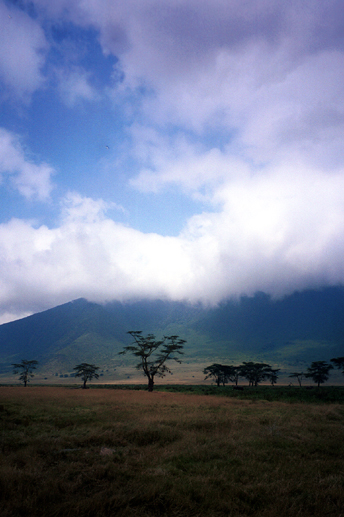
Low Cloud Cover, July 2003
|

Ascent Road
|
There are only two roads into the Crater, one to go down and one to come up, although I am sure this changes as circumstances warrant.
(1)
The ascent and descent roads in the Crater are narrow and steep in some places, and quite literally have been carved out of the side of the Crater wall. The roads turn sharply as they wind up and down the side of the Crater, and in many places make hairpin curves, leaving little room on the side of the roads for miscues. Going in and out of the Crater can be an adventure in itself, especially if you are afraid of heights.
|
|
On our first trip to Ngorongoro in 1991, we arrived at the rim of the Crater in the early afternoon, having left Oldupai Gorge behind. We stopped at the top of the descent-road to work on one of the land rovers which had overheated on the trip from the Gorge. The drivers had to allow the radiator to cool before they could add water. Stationed at the top of this road stood five Masai males, ranging in age from their mid-teens to mid-twenties, dressed in their full tribal regalia. The Masai generally live in temporary villages, moving when their grazing areas are depleted, and are a pastoral people who have resisted pressures to change their dress and customs. It appeared to me, however, that these five individuals had abandoned their pastoral life in favor of what appeared to be a full time job and an embracement of capitalism.
We had been informed before coming to Tanzania that we should not take pictures of the Masai without their permission. If we did, there could be substantial trouble and we might encounter a violent reaction. Gary was sure to reinforce this admonishment while we were stopped. I never did receive an adequate explanation as to why there would be a problem. Members of our group offered explanations ranging from religious reasons (taking a picture “captured” their soul) to humility. I, for one, was somewhat skeptical of these reasons, especially given the fact that the Masai would allow their picture to be taken if the photographer in question paid the going fare. This was more than adequately demonstrated by these particular gentlemen.
Several members of our group were anxious to take their picture. After several discussions amongst themselves, one of our people approached the gentlemen to inquire if they would mind if their picture was taken. The oldest of the group responded that they would be more than willing to pose for us, but first they would have to be paid 500 shillings per person. We made a counter-offer, and the Masai finally agreed to one picture per photographer of all five of them. Once the currency changed hands, they happily posed. Apparently this custom of being paid dates back many years when Europeans first started visiting the Masai. Those people had learned that the photographers were willing to pay for the pictures, so the Masai apparently had decided that it would be imprudent to give away something for which they could otherwise be compensated. I believe the Masai of later generations had merely built upon this practice. It seemed to me that this is what these particular five tribesmen were doing, and they probably earned more by posing for pictures for the tourists than they otherwise could have made with some other endeavor. I certainly could not fault them for their ingenuity, and I was glad to see that they had so expertly grasped capitalism.
Descending 1,500 feet into the Crater in less than two miles of road, we were given a panoramic view of the caldera. The top and Crater sides in many places are covered in thick vegetation, with the trees and shrubs forming a luscious, jungle-like carpet where we entered the Crater. Lake Makat, a soda lake, was clearly visible and was lined with flamingoes. I could make out roads criss-crossing the Crater floor, becoming more prominent the closer we neared the caldera’s bed. The Lerai Forest could be seen off to the one side, and strips of trees marked the presence of several small streams and rivers. Most of the Crater floor, however, was flat and covered in short grasses, still green but quickly fading to brown in some areas. The sky for the most part was clear and blue, but clouds hung on one rim of the Crater. The sides of the Crater were always noticeable, as were other mountain peaks in the distance.
Our campsite was situated behind the hippo pond not far from a Crater wall in a clearing surrounded by acacia and yellow fever trees. By the time we arrived in camp, our tents and all of the other camp facilities had been assembled. Out tents were again laid out in a row, although closer together this time since we had less space than on the Serengeti. The showers and choos were out behind the tents, and the dining tent had been set up on the other side of the clearing not far from some thick vegetation. We were told that we should again limit our strolls to the inner perimeters of the camp. While the camp itself was safe, they could not vouch for what might be laying in the grasses and trees surrounding us. The camp was the same as in the Serengeti, with the same amenities being offered, such as the sun downer, evening drinks with ice, lights in the tents and warm water in the basins. The major differences were that we had substantially less space than in the Serengeti, and of course the scenery. Whereas the Serengeti campsite was mostly plains with intermittent trees, our campsite in the Crater was more of a jungle setting, as we were surrounded by thick vegetation. Also, the Crater’s walls loomed not far from us in the background. This lent itself to a completely different experience.
Although we ate all of our meals at our campsite during our first trip, on our second trip in 2003 we had breakfast in the Lodge and ate lunch picnic style near the hippo pond. The problem was that all visitors to the Crater ate lunch at the hippo pond and the local birds have become used to being fed. Many had become quite forward and often would swoop into guests and grab food from the hands of the unwary.
Ngorongoro Crater offered what I considered the best of game viewing in East Africa as well as the worst. As far as the best was concerned, there were numerous animals in the Crater concentrated in a small area. The setting could not have been more conducive to beautiful photographs, with each picture framed by the wall of the Crater in the background. All of the animals were accustomed to the presence of land rovers and other sight-seeing vehicles, and much less skittish than those animals we encountered at Tarangire or in the Serengeti. As a result, they allowed us to approach much closer than the animals we had seen earlier in our trip. All of this combined for fantastic game viewing. But there was a down-side. Because the Crater is such an excellent place for game viewing, it attracts a large number of tourists each year. This results in what I consider the worst of game viewing, that is, too many people. During the day in the Crater, we virtually could not drive anywhere without other sight-seeing vehicles also being present. Whenever an interesting animal would be encountered, such as a rhino, tourist vehicles would converge upon the spot. This usually made the animal more nervous and hindered our access to an unobstructed view of the animal in question. After our experiences in Tarangire and the Serengeti where for the most part we viewed animals without other people present, this mass of people, to me, detracted from our viewing pleasure. I acknowledge that this is a rather conceited point of view on my part. I also was one of the people in a land rover converging upon an animal in the Crater, and just as the other tourists were obstructing my view, I was obstructing theirs. And as they were detracting from my game viewing enjoyment, I was detracting from theirs. So they can say the same about me just as I have complained about them. The real problem is how to control the large number of tourists traveling through the Park during a year, and counterbalancing this with the legitimate needs of attracting tourists and raising funds necessary for the continued conservation of the animals along with the rights of people to view these animals, and with the legitimate needs of protecting the animals and their habitats from being destroyed by the presence of too many people. The purpose of this book is to encourage people to travel to Africa and experience the animals and people of the region. Unfortunately, too many people at the same time making such a trip, to me, is not a positive result. Besides dealing with tourists and caring for the animals, the Tanzanian government must also deal with the legitimate needs of their people, especially the need for land, which I believe is the greatest danger to the animals today. There has to be a medium that will satisfy all needs. I, for one, do not have the best answer, but I do believe the Tanzanian Park Service is coping the best it can under the circumstances. It seemed to me that this problem, however, is more manifest in the Crater, given the smaller and more concentrated area that it covers.
|

Lake Macat Lined with Flamingos

Lerai Forest
|
The most prominent feature of Ngorongoro Crater is the large soda lake, Lake Makat (also known as Lake Magadi). The Lake was full during our first visit, although a large amount of the dried lake bed, with its white crusty film, could be seen. The Lake is dependent upon rainfall for its continued existence and was fairly dry during our second visit. Like Lake Ndutu, flamingos lined Lake Makat. When viewing the Lake from the top of Ngorongoro, it seemed to have a pink colored rim encircling it.
Not far from the Lake is the Lerai Forest, which is comprised of acres of acacia and yellow fever trees. The forest is inhabited by vervet monkeys and baboons and supposedly leopards, but we did not encounter the latter. A road winds through the center of the forest and, once inside, the trees and other vegetation are so thick that we could not see out. We made several trips through the forest, one reason being that Irene enjoyed seeing the monkeys and the other being that we were in hopes of spotting a leopard. Around the edge of the forest I noticed quite a few dead trees laying on the ground. I could not tell whether these had possibly been knocked over by elephants, or whether the edges of the forest were receding. I did think it strange how abruptly the grasslands of the Crater ended next to the taller trees of the forest. I would have thought there would have been a slow change between the grasslands and woodlands, possibly with some smaller brush between the two. But I saw no evidence of such a buffer zone. The forest was at its prettiest either early in the morning or late in the evening when the sun was lower in altitude. The soft light accented the yellow tinge of the yellow fever trees, creating a yellow haze around the forest.
|
|
Down from the Lerai Forest and off to the side is the hippo pond, behind which our campsite sat. The hippo pond is a small lake, or pond, which derives its name from the pod of hippos residing next to it. Unlike Lake Makat, this pond was not a soda lake, although I am not sure as to the source of its water in that I never saw a stream emptying into it. The pond is surrounded by large reeds on most sides and sits in a slight depression. A gravel road swings down along the side of the pond to an area which is mostly free of brush. I do not believe that we ever passed this small lake when it did not contain some sort of animal life, whether hippos, zebras or birds or some combination of all three, although admittedly the hippos more often than not were sleeping on the far bank as opposed to swimming in the pool.
|

Hippo Pond
|
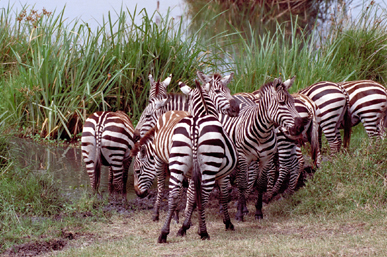
Zebra at the Hippo Pool
|
|
Another prominent feature of the Crater are the walls of the Crater itself. They form a backdrop for almost every picture. The walls were wavy, and most were covered in thick vegetation, but not always. They added a sense of isolation to the entire landscape. Historically, the Masai and possibly other tribes had utilized the Crater for pasture land for their cattle and for other purposes. When the Tanzanian government converted Ngorongoro Crater to a conservation area, it moved the Masai out of the Crater and prohibited them from using the Crater floor as pasture land. However, the government apparently agreed that the Masai could utilize the interior walls of the Crater during the day, but not overnight. On several occasions while driving around the Crater floor, I noticed herds of cattle walking along the side of the Crater wall, being tended by one or two Masai tribesmen. They would drive their cattle over the top of the Crater lip in areas which were fairly accessible, some time in the early morning, and then leave the Crater in late afternoon, only to return the next day. I can only imagine that the grasses on the walls of the Crater were better than what could be found outside the Crater itself. Otherwise, the Masai would have no reason to bring their cattle to the Crater to graze. Whenever I saw the cattle, I did not see other animals in close proximity to them. I wondered if the Masai had problems with predators attacking their herds, or whether the lions and hyenas left them alone and concentrated on the other hoof animals that were present in the Crater in larger numbers and not guarded by the Masai.
|
|
As I noted earlier, Ngorongoro is a paradise for game viewing, home to large herds of hoofed animals, as well as rhinos, elephants and predators. During our stay at Ngorongoro, we encountered a large herd of buffalo in one of the farther corners of the Crater. As we approached, the entire herd moved away, but several of the older animals surged back towards us. The three in front paid particularly close attention to our activities, never letting us out of their sight until we had moved on down the road. I imagined that they considered themselves the protectors of the other buffaloes in their herd, ready to attack if the need arose. I also imagined that they would be a nasty animal to confront, given the size of the massive horns on the top of their heads.
|
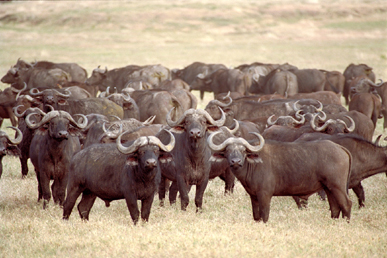
Cape Buffalo Herd
|
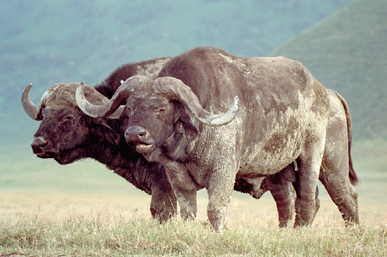
Old Dagga Boys
|
One evening we passed three or four old buffalo standing by themselves near the soda lake. Their bodies were encrusted in dried mud as a protection against the flies. One of the buffalo had strands of grass hanging from its head and ears, some of which was old and some of which was fairly fresh. He wore it proudly, as if jewelry and his most prized possession. The ears of these animals had been torn away, testimony to the rigors of a long life in the Crater. Gary referred to these buffalo as “Old Dagga Boys”, the translation for which I do not know. These were large animals and, standing there by themselves, they seemed proud survivors of a life in the Crater that probably was not too easy, especially given the fact that we saw the skeletal remains of two buffalo who had been killed during our short stay in the Crater.
|
|
Around a dozen hippos resided around the hippo pond. These could be seen either basking in the sun across the pond in a clearing in the tall reeds, or else swimming in the pond itself. Mostly the ones that we saw were laying in the sun. We did spot a baby laying next to its mother. Waterfowl floated around the pond or perched in the trees which lined its edges. The hippos left the pond at night to feed, and returned to the water at dawn for protection from the sun. Hippos apparently are a very dangerous animal, with more people killed by them in Africa than by any other animal. We were cautioned not to walk down by the hippo pond and place ourselves between the hippos and the water.
On an early morning game drive, with the sun not yet visible over the top of the Crater walls and available light very low, not far from our campsite we encountered two black rhinos in very close proximity to a male and female lion. The rhinos seemed very annoyed by the lions’ presence, and the larger rhino charged the cats. The male lion roared in defiance, swiping one of its huge paws at the charging animal, but the rhino, undeterred, kept coming. The mighty king of beasts retreated grudgingly, roaring the entire way. The two rhinos were a mother/child pairing, possibly explaining the aggressive behavior of the female rhino in protecting her young. We were to sight several more black rhinos during our game drives in the Crater, usually near the Crater’s soda lake. We were able to approach one group rather close, but the most activity that we could engender was a dispassionate look from one of the animals who merely opened his eyes to glance at us, not bothering to raise his head. Every one of the rhinos that we saw were caked in mud. This was in stark contrast to the rhinos that Irene and I had seen at our local Zoo, none of whom wore mud on their skin.
|

|

|
|
Black Rhinocerous
|
|
Even on our second trip to the Crater we encountered several black rhinos, although usually at a fair distance. We were lucky one morning when we spotted a rhino in the distance, but headed towards us. Patience paid off as the animal came close to the road. However, by the time he arrived, so had a large number of other safari vehicles. Apparently bothered by their presence, he soon sped away and into the distance. But again we had excellent rhino sightings in the Crater.
|

Black Rhinocerous
|
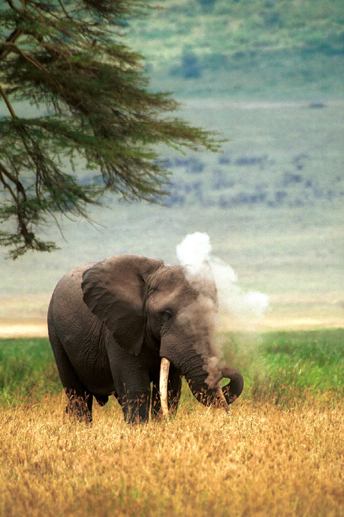
Elephant Taking a Dust Bath
|
We only encountered bull elephants in the Crater and no females or young. I am unsure as to why there were only male elephants, although I am sure Gary explained it to our group on more than one occasion. I never did make a good count either of the number of the elephants in the Crater. The elephants that we saw were either alone or in pairs, although we did encounter a large group feeding in the tall grasses in a depression near one wall of the Crater and another one dusting himself.
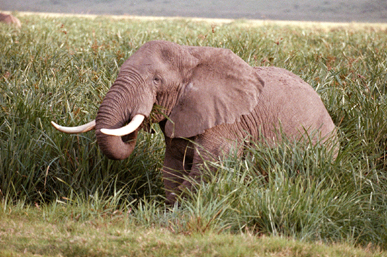
Bull Elephant Emerging from the Marsh
|
|
Another plentiful animal in the Crater was the zebra. We encountered them everywhere, even watering at the hippo pool.
The animals appeared very healthy and overall seemed in a better condition than the zebras on the Serengeti.
I do not know if they in fact were healthier or if they just appeared to be given that we were able to approach closer to
these zebras than those we encountered previously.
|
|
One afternoon, we approached a herd of zebra along one of the small streams that meanders through the Crater. The zebras were generally milling about and grazing on both sides of the stream. However, two of the males were clearly agitated with each other. One kept bothering the other, generally pushing him with his head or biting him. On at least two occasions, the victim (which I have labeled him although I may be incorrect) kicked the aggressor in the head, and with a substantial amount of force. The thuds of the hooves landing on the aggressor’s face could be heard in our land rover some seventy-five feet away. I do not know why the two were fighting, whether as part of a male dominance display or the one male trying to take over some females or for some other reason. The reasons were not readily apparent to an untrained eye such as mine, and Gary was not with us at that particular time to offer an explanation.
|

Zebra Fighting
|
|
There are several prides of lions in the Crater, and I believe that we encountered most if not all of them on our first trip. On our second trip we saw very few. In 1991, off the main road and along the road to the hippo pond, we usually saw a pride laying along the side of the hill. They invariably were sleeping, especially during midday or in the evening, many times just sprawled on their back with their paws and legs in the air. This must have been their territory and they were less than a mile from our campsite. One morning after breakfast, Irene and I decided to stay in camp and sleep and not go out on the midday game drive. This was the only game drive that I missed on our entire trip. However, after the vehicles returned, I cursed my decision not to go. Those who did came back excited about the five male lions they had come across down by the lake bed. The five apparently had just killed a buffalo and eaten until they were gorged. I was quite envious and wished I had joined them.
|

Male Lion Sleeping on His Back

Lioness, Thompson's Gazelle and Wildebeest
|
On the next game drive, our drivers headed back to the same place. To my surprise, the five lions were still there. We drove our land rover next to them, stopping near the head of one of the slumbering animals. Four were laying on the dried lake bed, and of these, three slept. The fourth laid on its stomach, as if in a daze. Their faces were encrusted and matted with blood, and none of them stirred. One was laying on its side, its mouth open, snorting and belching. We could see right into its mouth, its four canine teeth prominently displayed, reassuring every one that we did not want to tangle with this animal.
About a hundred yards or more away from the Lake, we encountered the fifth male lion, sleeping about three feet from the carcass of the buffalo. The buffalo’s body was intact except for its insides, the only thing remaining being a gaping hole where the stomach should have been. The lions apparently had fed on the entrails of their victim only and not on the rest of the body. Encircling the lion and its kill was a large number of vultures, marabou storks, hyenas and jackals, all of them wanting to feed on the remains of the buffalo. However, none of these scavengers would approach the carcass while the male lion was still present, even though it was sleeping. I counted two hyenas, two jackals, at least five or more marabou storks and more than thirty vultures. The next morning when we drove past the carcass, the male lion was gone and the scavengers were in the process of stripping the buffalo to its bones.
On our first trip into the Crater in 2003, shortly after we left the descent road, a lioness scurried across the road in front of, followed soon thereafter by two other lionesses. They soon disappeared out of sight, making their way away from the road. Our driver surmised that the two lionesses were chasing the first lioness out of their territory. Several minutes later, the two lionesses returned, causing a nearby herd of wildebeest and Thompson’s gazelles to take extra notice.
|
|
In its April 1992 volume, National Geographic carried an interesting story about the lions in the Ngorongoro Crater.
(2)
The authors had been able to trace all of the prides currently in the Crater to fifteen individuals. Apparently in 1962, most of the lions in the Crater had been wiped out by an unusual fly epidemic, with eight surviving. Seven others moved into the Crater in subsequent years. As a result of the natural isolation of the Crater, together with the inability of new male lions to enter the Crater and take over a territory from one of the existing prides, the lions in the Crater had been suffering terribly from inbreeding since around 1969. The article makes for very interesting reading, and gives a very good account of the Crater.
Like many Parks in Africa, the birdlife in the Crater was plentiful, making for excellent viewing.
Streams and lakes attracted many of the large birds of Africa, including the kori bustard, the ostrich, flamingoes, storks and pelicans.
|

Yellow-Billed Stork
|

Ostrich
|

Great White Pelican
|


Kori Bustard (top)/Saddle-Billed Stork
|
|
There was also a large population of grey crowned cranes in the Crater.
On our first trip into the Crater in 2003, Gary Clarke and I were riding alone in a Land Rover when we came across several of the crowned cranes engaged in a mating display.
The male spread his wings and jumped up and down, hoping to impress the nearby female.
This display lasted for some time, but apparently was not successful since the female ultimately left the male behind.

Grey Crowned Crane in Mating Dislay
|
|
There were several packs of spotted hyenas in the Crater. Usually, they were laying around in the grass or in their dens when we came across them. Although I never did see any of them make a kill, nor did I see any at any kill other than the one buffalo, we did encounter one individual whose forehead and face was still caked with dry blood, the only apparent remains of a recent meal.
|
|
On a late afternoon game drive, we drove to a hyena den situated on the edge of Lake Makat. Our driver had been attracted to this location by the head of the hyena that he saw sticking out of the hole. As we approached, two small cubs poked their heads out of the opening. They were cautious at first, barely sticking their noses out. Soon their heads followed, and finally their entire bodies. The adult hyena looked at us but did not seem concerned by our presence, as he (or she) allowed the cubs to come forward and play. We watched the cubs for several minutes by ourselves. They tumbled around together, alternating between playing with each other and watching us. Every once in awhile, they would dart back into their den, apparently startled by something, either real or imaginary, only to return to the surface once again.
|

Hyena Cubs
|
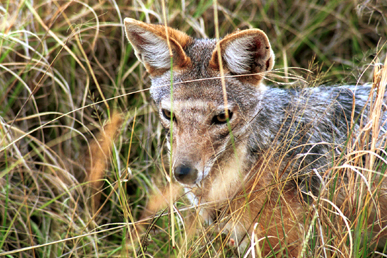
Black-Backed Jackal
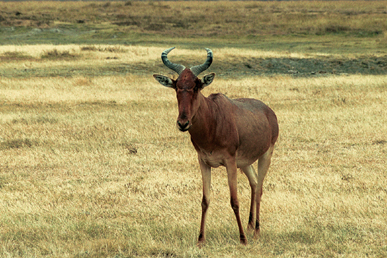
Kongoni (aka Coke's Hartebeest)

Wildebeest
|
Other animals found in the Crater included the black-backed jackal, the kongoni (an antelope similar to the topi), gazelles (both Thompson’s and Grant’s) and wildebeest, to name just a few. Again, because these animals have become acclimated to safari vehicles, we were able to approach them quite close.
One afternoon in 1991, as we were standing on top of Round Table Hill viewing the sights, we noticed a solitary land rover driving around with a large camera protruding from it. Gary asked our driver if he knew who was in the vehicle. He responded that it was Hugo and that they had been told to stay away from Hugo. Gary and several of the others seemed excited about this bit of information and explained to Irene and I that Hugo was Hugo van Lawick, but Irene and I were neophytes when it came to matters about East Africa, and the name meant nothing to us. We were not quite sure why Gary and the others were so excited. When we returned to camp, our camp operator approached Gary and told him that Hugo van Lawick was in the Crater filming and that he might be able to talk the gentleman into joining our group for lunch or dinner. Apparently he and Mr. van Lawick were friends, or at least very good acquaintances. As it turned out, Mr. van Lawick was more than glad to accept our invitation to lunch, and he joined us the next day in our dining tent.
Unknown to Irene and I at the time, Hugo van Lawick is a well known and well respected photo-journalist of East African wildlife. His first wife had been Jane Goodall, and he had supplied the majority of the photographs for her book, In the Shadow of Man.
(3)
He had also written several books himself and made several well known films. At lunch that day, Mr. van Lawick sat between Gary and I, and generally entertained our group with his tales and responded to questions. This was a very enjoyable encounter with a very interesting man. After lunch, Mr. van Lawick obligingly posed for pictures. Mr. van Lawick seemed to genuinely enjoy his encounter with our group, and we likewise enjoyed our encounter with him, brief as it was. Upon our return to the States, I obtained a copy of Mr. van Lawick’s book, Savage Paradise, The Predators of Serengeti,
(4)
and I now have a greater appreciation for the talents of Mr. van Lawick. I wish I had read the book prior to our trip as opposed to afterwards.
|

Grant's Gazelle
|

Thompson's Gazelleb>
|
|
In 2003, our group decided to visit a Masai village situated not far from the Crater. The villagers extended our group great hospitality as they shared their way of life and their culture with us. They were dressed in their bright red cloths and beads, and treated us to their tribal dancing and singing. It was very educational, especially for my children, to see how indigenous people in Africa lived. This provided us with a better appreciation for them and what they endure. One male even offered us 150 cows for our daughter. We declined graciously.
|

Masai Women
|

Masai Women Singing
|

Masai Demonstrating Their Jumping Skills
|
|
There are some points which I wish to make at this time with respect to camping in the Tanzanian National Parks since our camping experience for 1991 had drawn to a close. First, there is a possibility, although slight, of disease. This was brought to our attention in the person of Samuel, or more appropriately, the lack of Samuel. Samuel was a member of the camp crew and generally had been responsible for supplying the hot water to the showers, among a myriad of other responsibilities. We had all grown to recognize his smiling face as he cheerfully brought us the hot water. At the Crater, we noticed that Samuel was no longer amongst us. After inquiring, we were told that Samuel had been taken to a local hospital with a severe case of malaria.
Second, the campsites are situated in the middle of wild animals. We were assured that we would be perfectly safe inside the perimeters of the camp, but we were cautioned to be careful should we venture beyond those perimeters. For example, in the Crater, our particular campsite was the haunts of an old buffalo who liked to stroll through the area at night. It seemed prudent to stay inside our tents during the night to the extent possible so as to avoid an unwanted encounter. If we did venture out at night and encountered the old boy, we were cautioned to remain still and more than likely the buffalo would pass on without incident. In addition, across from our camp and in a clearing could be seen a group of baboons. We were warned that we should make sure our tents were securely and completely zipped at all times. The baboons had been known to enter tents from time to time and ransack the contents.
To my knowledge, none of the members of our group encountered the buffalo, nor did any baboon enter anyone’s tent. However, there was an encounter of two wild animals that I missed. Gary, who was lucky enough to witness it, gave this account of the sighting:
When I returned to the front of my tent [after visiting the choo], my tent mate (casually sitting in a chair under the canopy), pointed down the trail past our tent and said, “There goes a hyena.” And sure enough, there was a spotted hyena running across a clearing.
In the next instant he said “There goes a lion, chasing it”, and sure enough, there was an adult male lion running across the clearing. The one I’d just heard from the loo--and I know why the hyena was running!
Unfortunately, we did not see the lion chasing the hyena through our camp, although my wife thinks we were fortunate.
I do not count any of these as negative points with respect to camping in Africa, but rather consider them part of the total unique experience. When we stayed in the lodge in 2003, we missed some of what we experienced during our camping safari. We did not drive into the Crater until after we had eaten breakfast, missing some of the early morning antics of the animals. We also were required to leave early in order to return to the lodge prior to sunset, again missing some of the late evening game-viewing. I am sure that camping experiences are different for everyone, especially depending upon the particular operator. And not everyone may share this point of view. However, I had no complaints about our experiences in Tarangire, the Serengeti and Ngorongoro Crater. Ideally, the Crater will be opened to camping again sometime in the future. However, at this date, this does not appear likely.
I do not mean to denigrate the Serena Lodge. It was very nice nestled in the rim of the Crater. The bed was comfortable, the shower was hot and the food was good. Those working at the Lodge were quite friendly. In addition, the Lodge had a wonderful bar which we commandeered every evening we were there. My preference though is to camp under the stars in the midst of the animals.
Although colder and drier the second time around, Ngorongoro Crater offered our family a very good safari experience.
NEXT...Lake Manyara National Park
Footnotes
(1) I have also been told there is a back road into the Crater, although I have never seen it.
(2) Captives in the Wild, Craig Packer, National Geographic, Vol. 181, No. 4 (April 1992).
(3) Jane Goodall, Houghton Mifflin Company, Boston (1971).
(4) Hugo van Lawick, Collins Harvill, London (1977).
|
