The road from the Hotel to the Park wound down the face of the escarpment, which was thickly covered in shrubs and trees, forming a lush carpet of vegetation. By 2003, the road had been paved, making the journey much easier. The ground fell gently away from the escarpment and Lake Manyara could be seen extending to the horizon. At the base of the escarpment was the main entrance/exit to the Park, a dirt and gravel road marked by a wooden sign mounted on top of a pile of rocks. The entrance road was lined with acacia trees and led to a small building which operated as a combination museum/gift shop/registration building at which guests were required to register.
Although the Park is small, it does contain a variety of habitats, including the rift wall, a ground water forest, acacia woodlands, open grasslands, several rivers, two hot springs, swamps, marsh and Lake Manyara. The latter is a soda lake, formed after the formation of the Great Rift Escarpment. The Lake has varied in size over the centuries, apparently at its largest around 250,000 years ago. The water level today changes substantially during the year and from year to year depending upon the amount of rainfall. The Lake contains catfish and bream, which are caught for food by local residents, but outside of the Park. Fishing in the Park is prohibited.
Right inside the Park is the ground water forest, which is fed by seepage from the escarpment wall as opposed to substantial rainfall in the area. The forest is thick with vegetation, as well as with monkeys, but for some reason not with birdlife.
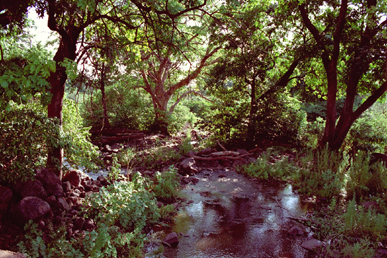
Ground Water Stream

Not far from the entrance, we passed several blue monkeys, some perched high in the trees, swinging and jumping from branch to branch, and others milling about on the ground. The monkeys were very difficult to see as they moved in and out of the bright sunlight that streaked through openings in the trees above. The monkeys did not venture near our vehicles, but scampered away and disappeared into the trees in the distance shortly after we made our appearance.

Besides the blue monkeys, a large number of vervet monkeys resided in the forest and throughout other wooded areas of the Park. One in particular was seated on the side of the road and refused to move as we drove by. He merely turned his head and looked at us as if he was perturbed that we were disturbing his day. That might explain how he lost his tail, which had been reduced to a stub a few inches long. At other sites, especially along fallen trees, we passed troops of vervets. There were many youngsters in the groups, clinging tightly to their mothers. They too would scamper away to the relative safety of the thick vegetation, out of our line of view, shortly after we approached. One of the vervet monkeys sitting on the side of the road in the shorter grasses generated some unusual interest with the ladies in our group. Its scrotum and genital area was an iridescent azure blue, which he was proudly displaying as we drove by. I do not know if this was a common feature at all times, or if the existence of that particular color was associated with some stage of mating, but I believe it is the former and not the latter. You can imagine the jokes that were flying about as we left this monkey behind.
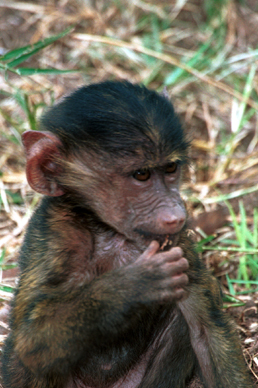
Baboon Baby
The other species of monkey prevalent throughout the Park was the baboon, although by our second trip the population had been ravaged by some disease. At one point, we noticed an acacia tree the top of which seemed to be moving. The rest of the trees in the area were very still and there was no appreciable wind blowing. As we neared, we saw the source of this movement. A troop of baboons were swarming throughout the tree, jumping from branch to branch, feeding off the pods of the tree. There were dozens of monkeys of various sizes in this tree, all intent on eating and generally ignoring us. Later, we passed a large male baboon sitting on a fallen tree about fifteen feet from the side of the road. As we approached, he flashed his canine teeth at us. The teeth were large and capable of inflicting grievous injury. I do not know if this was a warning, a dominance display, a threatening gesture or what. It only happened this one time and with this particular male, at least that I noticed. Other baboons we encountered were busy grooming, pulling insects from the fur of others and eating the insects. Some youngsters, darker in color than the adults, could be seen in these groups. The youngsters seemed more curious about their surroundings, and certainly us, than the older baboons. Like the young of most animals, the young baboons were quite cute and cuddly. Irene was fascinated by these monkeys and we spent a considerable amount of time watching them.

A Mother Consoling Her Young
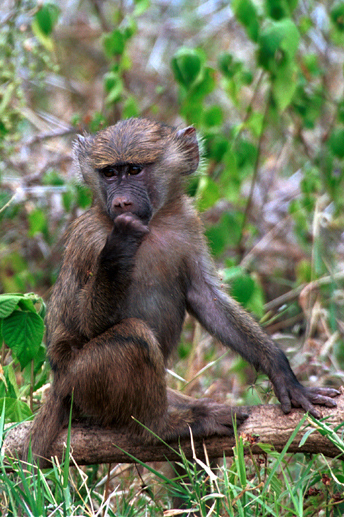
Another Inquisitive Youngster
The birds in the ground water forest are relatively scarce. I am not sure why, but the book published by the Tanzania National Parks suggested that the monkeys in the forest, which were quite numerous, probably eat the eggs of birds who nested there. As a result, there would not be that many birds present, as they would nest in other areas for the survival of their young.

Ground Hornbill Perched in a Tree

Silvery-Cheeked Hornbill
Lake Manyara National Park is well known for two things: lions in trees and elephants. However, the Park did not live up to this reputation while we were there. With respect to lions, we neither saw any lions nor signs of lions. The most we saw during our first trip was wire fencing wrapped around the base of several trees, which we speculated was there to assist the lions in climbing the trees and satisfy the tourists who expected to see the lions in the trees. Gary was particularly disturbed by the presence of the fencing in that he thought man should not attempt to induce artificially what nature was not doing naturally. Although the Park’s history included lions in trees, both Gary and other members of our group who had previously visited the Park indicated that they rarely saw the cats perched on tree branches in the Park. Rather, they had experienced this phenomenon more often in the Crater. Although the Park was attempting to satisfy the desires of visitors and induce lions to climb trees, it apparently was not successful in its endeavors. We did not notice any fencing the second time around.
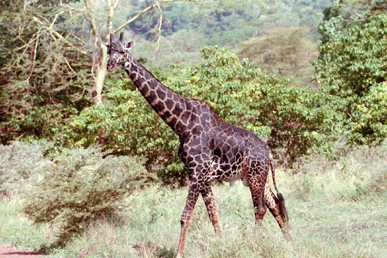
Masai Giraffe
There was a large population of Masai giraffes in the Park during both trips. One that we came across was an old, tall, dark male virtually black in color. Watching us the entire way, he sauntered across the road in front of us, taking his time as if he had all day, which he did. Not far from this older giraffe and across the road stood two younger males, engaged in a male domination display. About forty feet from the road in a small clearing, the two were busy shoving and beating on each other in an apparent attempt to determine who was the more dominant. Although fully grown, they did not appear to me to be very old. The occupants of our land rover sat watching, quite mesmerized, as the two faced off, alternating between ramming their bodies into each other and using the back of their heads as hammers, slamming it into the other. It was like watching two animals in slow motion, as their heads reared back and then lurched forward into their opponent. The necks of the two giraffes ended up twisted in all different shapes, some of which I previously thought would be impossible for a giraffe to achieve. The sound of the impact reverberated all the way to our land rover. Irene quite appropriately referred to the display as “necking”. After fifteen or twenty minutes of this, the two giraffes stopped and departed, each going its separate way, neither one demonstrating any apparent injury from the encounter. These displays apparently happened quite often and rarely resulted in either animal permanently injuring the other.


Masai Giraffe - Male Dominance Display
As to elephants, Iain and Oria Douglas-Hamilton had conducted a famous study of the animals at Lake Manyara, which study was documented in the book Among the Elephants. (2) Unfortunately, poaching had decimated the elephant herds in the Park over the years, and we did not see a single elephant during our first visit. However, on our second trip in 2003, we encountered several elephants feeding in the tall brush.

Elephant Foraging in the Thick Brush and Trees
Although small, Lake Manyara National Park has a very diverse topography. A ground water forest lies close to the entrance. Numerous streams cut through the forest, as well as through other areas of the Park, much of which is picturesque. Near the Lake, the ground is flat and covered mostly in short grasses. The face of the rift can be seen in the distance, weaving in and out around the Lake. Other parts of the Park are covered by taller grasses and/or trees. There are several rivers traversing the Park as well as two hot springs. The Minor Hot Springs, which lies closest to the entrance, has a sustained temperature of 40° centigrade. A very unpleasant smell of sulfur hangs in the air around the spring. We did not drive to the Major Hot Springs, which is much deeper in the Park, and the temperature of which I am told is sustained around 60° centigrade.
The Park has a hippo pool, which is actually part of the Simba River which runs close to Lake Manyara. I understand that, between 1991 and 2003 during one of the el Nina years, there was substantial flooding throughout Tanzania and that the Simba River was rerouted by the forces of nature. The hippo pool remains, but the surrounding landscape was changed substantially. In any event, on both trips, a number of hippos relaxed in the pool, all submerged in the water, with only their heads and backs showing. Although hippos can be quite aggressive, especially the adult males, we only saw placid animals, not only here but in the Serengeti and Ngorongoro as well. Behind the hippo pool lies a small strip of land bordered on the other side by Lake Manyara. During 1991, this small strip of land was covered by thousands of pelicans and other birds, ranging from herons to egrets to teals to spoonbills and the like. It was a birders paradise, and Irene was in heaven. Most of the birds in 2003 were Egyptian geese. Gone were the numerous pelicans and other birds.

Hippos, Pelicans and Other Birds in the Simba River
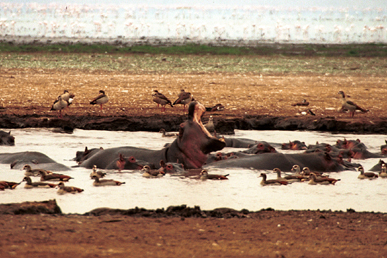
Hippos in the Simba River
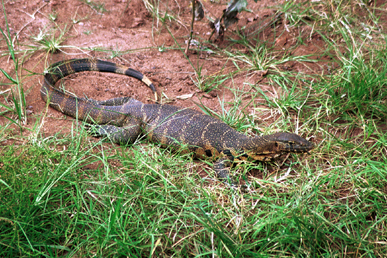
Monitor lizard
Lake Manyara National Park reportedly has a large population of monitor lizards. In 1991, we saw a glimpse of one as it ran into the thick bush of the forest. However, in 2003, we came across a substantial specimen sunning itself underneath a bridge. It was one of several that we saw on this particular safari.
One of my more memorable encounters came late in the day of our second trip to the Park. We rounded a curve in the road and came upon a troop of baboon feeding. We parked the vehicles and watched as the animals interacted, alternating between feeding, grooming and looking after the youngsters. After several minutes, a herd of male impalas strolled in and began to feed among the baboons. Strangely, the baboons did not react to their presence but continued on with their activities. I had never encountered impalas so close before. Usually, whenever we neared, they moved away. However, these impalas basically ignored us as they fed. After ten or fifteen minutes, they did depart, as did we.

Impala Feeding Amongst the Baboons


Lake Manyara National Park was the last stop on both of our safaris to northern Tanzania. I do think one day of game viewing was sufficient for touring the Park. The number of different animal sightings at Lake Manyara was not great, especially when compared to the other Parks we had visited on our safaris. On our first trip, there were several stretches where we drove for miles without encountering an animal. In addition, in 1991 the Park was crowded with other tourists, although it did not seem as crowded in 2003. Gary later told us that he probably would have by-passed Lake Manyara in its entirety on the 1991 trip except that we were passing right next to the Park going and coming from the Serengeti and the Crater. In addition, he wanted our group to stay at the Lake Manyara Hotel, both for its magnificent view from the top of the escarpment and to ease our group back into civilization. The same could be said for the Serena Safari Lodge.
I believe you could opt for one day of game viewing at the Park and forego a stay above Lake Manyara. I would support such a decision in that Lake Manyara National Park is my least favorite National Park in northern Tanzania. However, given some of the interesting sightings in Manyara, and given that game viewing in East Africa can change quite frequently and the Park may have become an excellent place to visit for an extended tour once again, I would not recommend bypassing it completely.
Footnotes
(1) Lake Manyara National Park, Deborah Snelson, Tanzania National Parks in cooperation with the African Wildlife Foundation (June 1986), p.3.
(2) Among the Elephants, Iain and Oria Douglas-Hamilton, Penguin Books Ltd. (1978).